





In the new edition of the QS Top 50 Under 50, released this week, Singapore’s Nanyang Technological University (NTU) was once again ranked as the the world’s top university under 50 years old, closely followed by the Hong Kong University of Science and Technology (HKUST).
In general, dynamic young Asian universities dominate the top tier of the QS Top 50 Under 50, which celebrates the world’s leading institutions under 50 years old. NTU and HKUST are joined in the top five by two more Asian universities: South Korea’s KAIST at third, and the City University of Hong Kong at fifth.
While Nanyang Technological University has now led the Top 50 Under 50 for five consecutive years, HKUST has previously claimed the top spot, and the two remain closely matched.
Here’s a closer look at how these two ambitious Asian universities compare…
|
|
Nanyang Technological University (NTU) |
Hong Kong University of Science and Technology (HKUST) |
|
QS World University Rankings® 2019 |
Ranked 12th in the world overall in 2019 Ranked 11th in the world by academics and 18th by employers 79th for faculty/studio ratio 87th for research impact (citations per faculty member) 24th for percentage of international faculty members, and 144th for international students
|
Ranked 37th in the world
241st for faculty/student ratio 39th for research impact (citations per faculty member) 15th for percentage of international faculty members, and 114th for international students |
|
Subject strengths* |
Ranked 61st in the world for arts & humanities Fifth for engineering & technology 130th for life sciences & medicine 19th for natural sciences 29th for social sciences & management |
Ranked 164th in the world for arts and humanities Joint 17th for engineering & technology Joint 330th for life sciences & medicine Joint 48th for natural sciences 24th for social sciences & management |
|
Location |
The main Yunnan Garden Campus is in western Singapore, close to the Johor Strait which separates Singapore from Malaysia. |
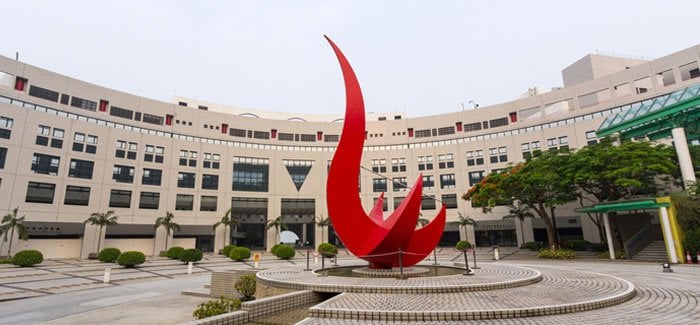
About 30 minutes’ drive from central Hong Kong, overlooking the Clear Water Bay Peninsula, in the south-east of Hong Kong. |
|
History & vision |
Founded in 1991, with the vision of being “a great global university founded on science and technology” and a mission of “nurturing creative and entrepreneurial leaders through a broad education in diverse disciplines”. |
Established in 1991, focusing on teaching and research in science, technology, engineering and business studies, with the vision of becoming “a leading university with significant international impact and strong local commitment”. |
|
Student community |
Around 31,827 students, of which 8,074 are postgraduates. |
Approx. 14,807 students, of which 5,053 are postgraduates. |
|
International tuition fees |
Undergraduate students who aren’t subsidized by the MOE Tuition Grant will pay S$31,780-36,830 (~US$23,665-27,260) per year for most courses. Master’s degrees at NTU start at S$30,100 (~US$22,430) a year without service obligation (see ‘Tuition Fees’ section below. |
For 2018-19, annual fees for most undergraduate programs are HK$140,000 (~US17,150).
|
|
QS Best Student Cities 2018 rank |
Singapore currently ranks 15th in the QS Best Student Cities ranking. |
Hong Kong is 12th in the QS Best Student Cities. |
*Based on the broad subject areas of the QS World University Rankings by Subject 2018.
QS World University Rankings® 2019
Nanyang Technological University (NTU) continues to outrank Hong Kong University of Science and Technology (HKUST) in the QS World University Rankings® and the QS Top 50 Under 50, with both top Asian universities down slightly on last year.
When taking a closer look, both institutions perform well in the indicators used to compile the rankings, with each university ranked in the top 300 for each one. NTU achieves higher scores for its reputations among academics and graduate employers, gaining a wider lead on the employer reputation indicator.
For research impact, HKUST is the leader of the two, with NTU ranked 87th. This is assessed by counting the number of research citations published per faculty member at the university. However, when assessing the ratio of academic staff members to students, NTU has a clear lead – ranked more than 160 places ahead of HKUST at 79th.
Finally, looking at the level of international diversity on each campus, both young universities get high scores, with HKUST in the lead both for its percentage of international faculty members and international students – however, NTU still features in the global top 150 for both indicators.







Get closer to your dream programme
Your consent preferences have been set.
Time to start exploring.
Your account has been removed.
You can still browse the site or sign up again once you have parental consent.
Get closer to your dream programme